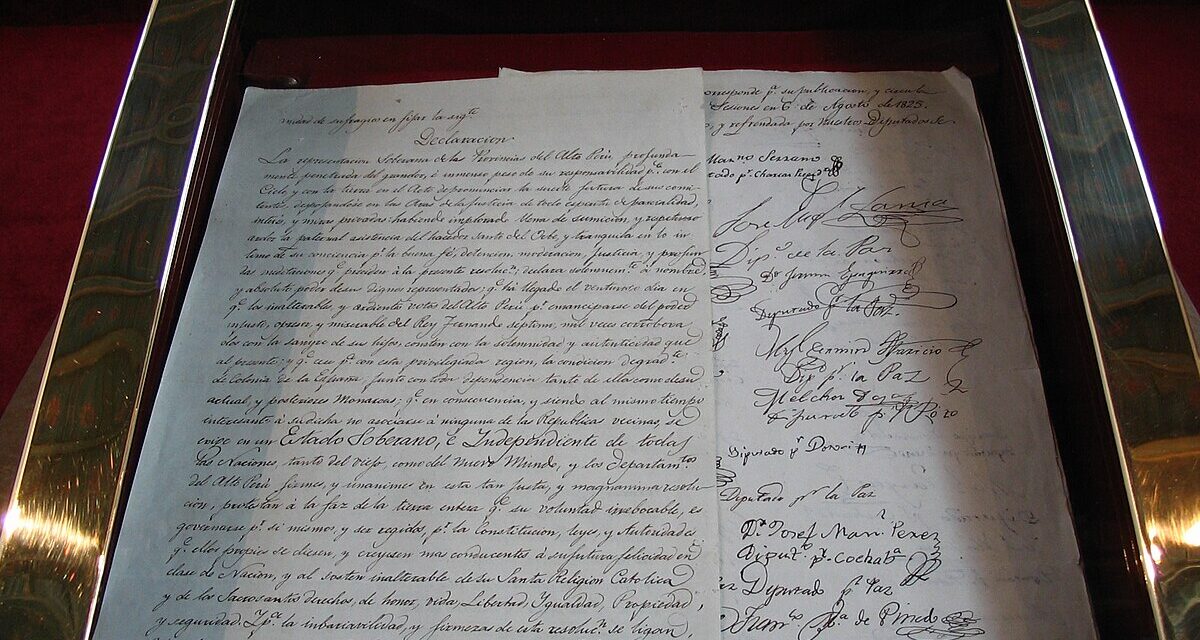
The foundation of Bolivia on August 6, 1825, marked a milestone in South American history. In the assembly of Alto Peru, representatives from the four provinces (La Paz, Potosí, Charcas or La Plata [including Oruro], Cochabamba [including Santa Cruz]) made significant decisions in the «Hall of Liberty,» now located in Sucre. The construction of a new independent country emerged as the unanimous choice even before the formal vote.
The Birth of Bolivia: A Consolidated Political Project
Two assemblies played a crucial role in this process: the Assembly of Deputies convened by José Antonio de Sucre in February 1825 and the Constituent Assembly convened in November of the same year. The first culminated in the Declaration of Independence and the adoption of a government «concentrated, general, and unified for the entire republic and its departments.» The second, in turn, provided the country with a new Constitution, thus establishing the foundations of a new political unity rooted in the territories of the former Audiencia de Charcas.
Bolivia Defying Adversity
Despite an unfavorable economic context marked by years of war and resource looting, political determination and the construction of a new nation characterized much of the 19th century in Bolivia. Although the economy did not offer guarantees, leaders of the time, such as Antonio José de Sucre and Andrés de Santa Cruz, implemented reforms and sought to integrate the country into powerful confederations.
Breaks with colonial laws materialized in the creation of new codes, while the consolidation of modern popular sovereignty was reflected in the rules of political participation. The importance of military figures, caudillos, and «revolutions» became defining elements of the political culture of that time.
Construction, Education, and Social Challenges
Building the country also meant reorganizing its political-administrative structure, naming places after Independence heroes, and exploring territories. The challenge of educating the population led to the implementation of an educational system led by Simón Rodríguez, who considered education as the lever for social change.
Belzu, on the other hand, promoted education for artisans, giving rise to the first newspapers about this profession. Higher education also became a prominent project of the 19th century. The country’s economic situation prompted deep reflections on wealth and the so-called «misery,» as well as the economic policies of the time.
Cultural Change: From Literature to Civic Celebrations
From literature to the press, architecture to street festivals, and painting to music, various cultural expressions highlight the changes brought about by the Republic. Reflections on the wealth and «misery» of the country extended from intellectual circles to the economic policies of the time.
Republican Legacy: Education and Civic Celebrations
Finally, the birth of the Republic crystallizes in education and civic celebrations, nourishing the construction of the memory of the new nation year after year. Bolivia, despite its initial economic challenges, stands as an example of resilience and determination in forging its national identity.
This article is a journey through the dawn of Bolivia as an independent nation, exploring the challenges, achievements, and transformations that marked the path to the consolidation of its own state.